On the Road to Kinale
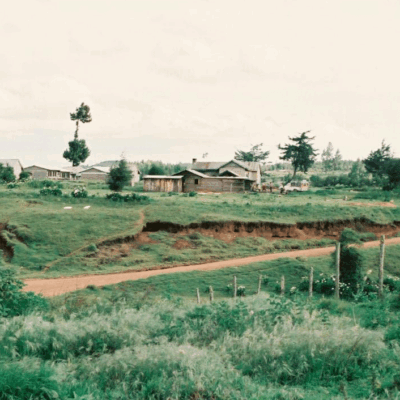
To get to the town of Kinale — a small settlement of mud huts and brick-and-mortar blocks situated in the high country along the Western edge of the Great Rift Valley in Kenya, East Africa — one must negotiate four miles of evergreen-forested terrain, the distance between the Nairobi Highway and the village itself. This negotiation is abetted by an unnamed road connecting the two points, a dirt track that can, at least in the brief dry season, accommodate, along with the plentiful bicycles and ubiquitous humans on foot, actual cars, a rare mode of travel in this poor, rural...
The Longest Extra Time
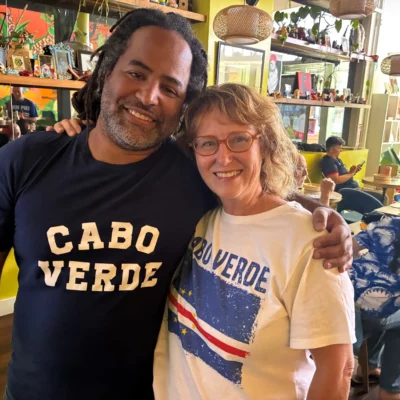
Jill Tucker sat quietly in a bar, watching the World Cup match unfold on the TV with everyone else, when a man sitting nearby addressed her: “You were my teacher.” Tucker had served the Peace Corps in 1990, teaching English for two years in the Capital of Cape Verde, Praia. Thirty-five years later, Ivan, a student in her class, wound up at the very same bar that night, watching the World Cup, too. When Tucker finished her Peace Corps service in 1992, there was no video call or social media to keep her connected to her students or the friends...

Peter Pan Syndrome
From the air I view the Congo river, a muddy, meandering waterflow whose breadth where it separates Brazzaville from Kinshasa is truly impressive. Though I first came to Africa twenty years before, such names still captivate me even if I can now lecture on the difference between Congo-Brazza and Congo-Kinshasa, between Guinea-Bissau, Guinea-Conakry, and Equatorial Guinea. Though I graduated college without knowing the difference between Niger and Nigeria, I have since written books about them. And still, a journey through Africa excites me as much as my original atlas explorations did as a boy. All thanks to the Peace Corps....
Carrying the Torch of Liberty
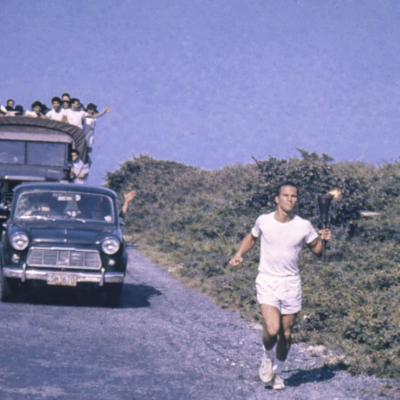
Here in the Washington, DC area, where public service, education, and community roots run deep, we understand the quiet impact one life can have. My father, Victor Joseph Corbin, is one of those lives. As part of the Peace Corps’ earliest pilot program under President John F. Kennedy, he served in Costa Rica in the early 1960s. He didn’t observe from a distance. He immersed himself fully, working alongside local families, helping build infrastructure, teaching English, and becoming part of daily life. He didn’t just serve the community. He became part of it. That mattered. In the early 1960s, during...

Wave of Inspiration
When thinking about the legacy of Peace Corps, we as a community often cite with pride John F. Kennedy's speech at the University of Michigan in 1960, where the idea of Peace Corps was first articulated, and the astounding reception his call to service received when more than 1,000 young Americans signed a petition in support of the idea and offered to join up. "How many of you who are going to be doctors are willing to spend your days in Ghana?" Kennedy asked. "Technicians or engineers, how many of you are willing to work in the Foreign Service and...

The Stream: Spring/Summer 2026 – RPCV Book Reviews
RPCV BOOK REVIEWS FEATURED REVIEW We Called It a War by Sargent Shriver Shriver's posthumous memoir—written in 1960 but only recently rediscovered in the archives of the Shriver Peace Institute and edited for contemporary readers—offers a detailed account of the 1964–68 War on Poverty. The narrative illuminates Shriver's political acumen, details with equanimity his relationships with allies, adversaries, and leading figures of this time—most notably LBJ—and displays the strong spiritual fidelity with which he appears to have approached everything. Among the memorable anecdotes of his efforts to make a meaningful impact on poverty in the U.S. is one in which...

Notable
How to Start a Tribal Art Museum Justin D. Bibee, a Peace Corps Volunteer in Morocco from 2014 to 2016, founded the Museum of Fine Tribal Art, a Rhode Island–based nonprofit established in 2025. The museum focuses on collecting, preserving, and sharing tribal art from Africa, Asia, Oceania, and the Americas. The museum began as Bibee's personal collection and has since developed into a public initiative. It includes masks, textiles, sculptures, jewelry, and ceremonial objects representing a wide range of cultural traditions. The collection could be valued at up to $6 million, based on preliminary research. Without a permanent exhibition...

The Jeep Driver’s Son
In 2003, Sam Sidiqi boarded a bus in Kabul in his best suit, heading back to the village on the outskirts of the city where his family had deep roots and where his uncle worked as a teacher. He was on summer break from business school in the U.S., and had just finished his first day of volunteering at Afghanistan’s central bank. Even though he'd left Afghanistan when he was 11 months old, the bus ride back home somehow felt familiar. When a man on the bus looked at him and asked where he was going, Sidiqi told him he...

The Advocate
When I graduated from college, I briefly considered joining Peace Corps. After some reflection, my decision was clear: “Spend two years living remotely in a foreign country? Absolutely not!” I could never have imagined that seven years later I would be on a tiny island in the Federated States of Micronesia starting service. Similarly, in 2003, when I was hired to help rebuild the advocacy program at the National Peace Corps Association (NPCA), it would have been hard for me to foresee that I’d close out my career running NPCA’s advocacy efforts more than twenty years later, in 2026, having...

When Caucasian Doesn’t Mean White
I was three months into my Peace Corps assignment in Georgia in 2003 when I first learned white folks back home were not, in fact, the real Caucasians. I was sitting in a small classroom in the village of Vale with some older teenagers who had recently traveled to Russia. During their time working in construction there they told me they were often called “Chorniy,” the Russian word for the color black. Contextually, the phrase can also be deployed as a slur against people from the Caucasus region. Every day, these young men told me they were racially harassed and...