

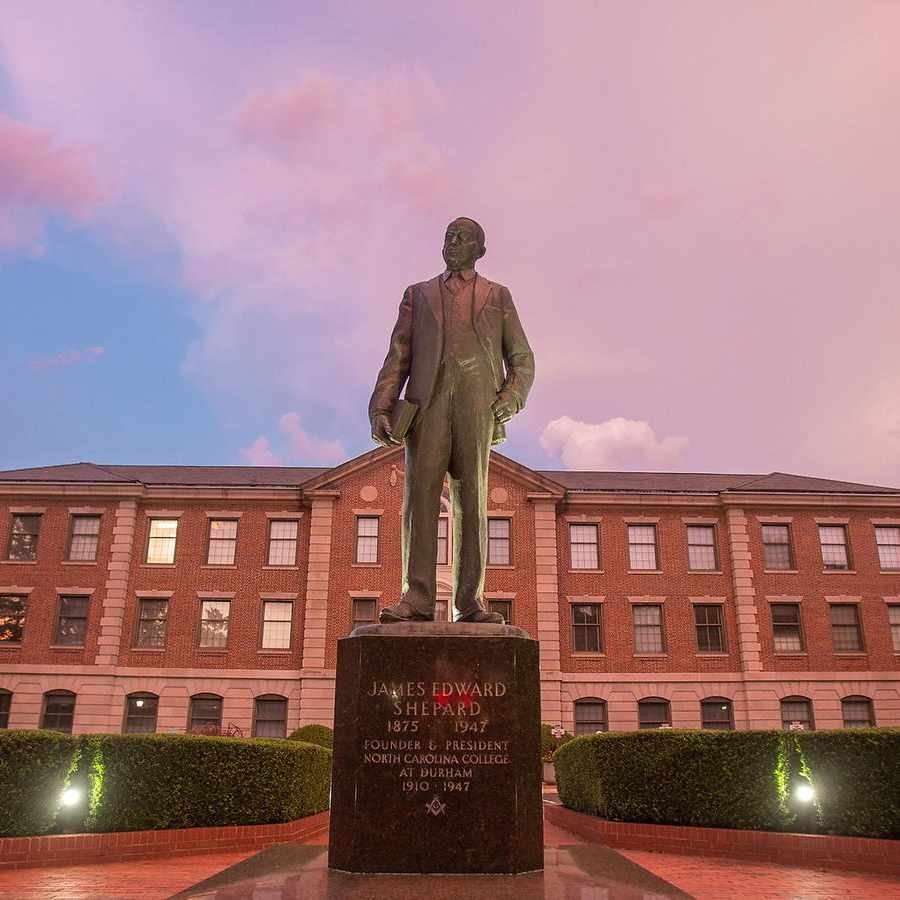
Why HBCUs Belong on Your Grad School List
Going beyond the familiar
Returned Peace Corps Volunteers know something about looking beyond the familiar.
When I arrived in Guinea as a Peace Corps Volunteer in 1996, I had already served in the U.S. Navy and graduated from North Carolina Central University, a historically Black university (HBCU). I taught mathematics in the community of Koba and began developing relationships, perspectives, and an understanding of service that would influence the rest of my professional life.
My career would eventually take me into international public health with the Centers for Disease Control and Prevention; back to the Peace Corps in executive leadership roles in Africa; and eventually back to my alma mater for my current role leading its Office of International Affairs.
I’ve learned a lot by applying my passions in different contexts, and those experiences have convinced me that the same curiosity that motivates us to pursue two years in the Peace Corps can be applied to choosing a graduate degree to spend two years doing a different kind of learning. It’s a significant commitment that demands an open mind.
For some, that means taking a serious look at historically Black colleges and universities.
Choosing your focus
RPCVs looking to build on their overseas experience with a graduate degree may be tempted to focus on graduate programs with “international” in their titles, but that narrow focus will more likely prevent them from seeing a breadth of options that may be a better fit for them.
Instead, they should begin with another question: What issue did my Peace Corps experience make me want to understand more deeply?
A Volunteer who thrived working closely with agriculture might find their passion reflected in programs in food security, agricultural development, or sustainability. Someone who served in a health center might find their calling in public health or epidemiology. RPCVs who were teachers or youth volunteers might consider education, counseling, or public policy.
For some RPCVs, law or public policy may be a natural continuation of service. Community work often puts us face to face with important questions on governance, migration, human rights, public health, economic development, environmental policy, and access to institutions. Legal and public-policy education can provide another set of tools for addressing those challenges.
Sure, some people may return from service interested specifically in international fields like diplomacy, migration or international development. But even though the Peace Corps experience took place far from home, Volunteers should think about what it was about the day-to-day of their experience that most engaged them.
The larger lesson is that sometimes the most appropriate route back into international work is not a degree in international affairs but specialized expertise that can be applied internationally.
No Single HBCU Graduate Experience
One of the first things prospective students should understand is that there is no single HBCU graduate school experience.
HBCUs include public and private universities, research institutions, and professional schools offering graduate education across disciplines ranging from international studies and public health to agriculture, engineering, law, business, education, environmental science, social work, and public administration.
There are graduate programs at HBCUs that fuel pathways for careers across the entire spectrum, and many of them include original programs that leverage unique resources that a school has to offer.
My understanding of the diversity of this landscape has grown through my leadership roles with the HBCU Member Interest Group at NAFSA: Association of International Educators, as well as my participation in Clark Atlanta University’s HBCU Executive Leadership Institute.
Working in this space has exposed me to institutions and colleagues approaching international education from very different academic and institutional perspectives, so I highlight some notable programs below — not as a ranking or recommendation, but as a snapshot of the variety of paths available to anyone considering higher education at an HBCU.
Of course, prospective students should confirm current admissions availability directly with the schools mentioned, as their offerings can change with new application cycles.
Notable Programs
For RPCVs interested specifically in international affairs and related degrees, programs like these can provide an academic framework for developing on experiences first encountered at the community level. A few standouts:
- Howard University in Washington D.C. illustrates the interdisciplinary possibilities available at a school that offers many degree programs. The school’s 15-credit Graduate Certificate in International Studies examines a range of subjects including diplomacy, international development, human rights, international law, global health, conflict, and the environment. The certificate incorporates a capstone internship or research project and can complement graduate study in fields such as African Studies, Economics, History, Political Science, and Sociology.
- Morgan State University in Baltimore, Maryland. offers a different model: a 33-credit Master of Arts in International Studies. Its program emphasizes analytical thinking, global governance, international affairs, policy analysis, and the Global South. Students can pursue areas such as business, project management, public health, literature, and culture, with regional concentrations that include Latin America, the Caribbean, sub-Saharan Africa, the Middle East, and Europe.
- North Carolina A&T State University demonstrates why returned Volunteers should define “international” more broadly. Its 12-credit Graduate Certificate in International Agricultural Development and Engagement focuses on international trade, policy analysis, project management, monitoring and evaluation, working across cultures, and addressing complex problems involving multiple stakeholders. The university also identifies research and experiential learning opportunities in the U.S. and abroad as part of the program.
- Tuskegee University in Alabama provides another example through its Ph.D. in Integrative Public Policy and Development. The interdisciplinary program addresses domestic and international development policy and includes an International Development Policy specialization emphasizing rural development in Africa, the African diaspora, and other regions of the Global South. Other specializations address agriculture and resource policy and history and public policy.
- North Carolina Central University, my alma mater and current employer, shows another dimension of the HBCU graduate and professional landscape through its School of Law, which includes several joint degrees in partnership with Duke University.
HBCUs and Financing
While the availability of programs at HBCUs matches anything offered by more mainstream institutions, it’s an unfortunate reality that financing options tend to be more limited at HBCUs.
Most relevant to RPCVs is the Peace Corps’ Paul D. Coverdell Fellows Program, which provides free or significantly discounted tuition at its partner universities, which give financial support to returned Volunteers while Fellows complete internships in underserved U.S. communities.
While HBCUs are significantly underrepresented among partner institutions in the current Coverdell landscape, they are not entirely absent; Xavier University of Louisiana is one HBCU that offers a Coverdell fellowship, for example.
I see that as an opportunity that I hope will motivate greater collaboration among Peace Corps, HBCU graduate schools, and the RPCV community to expand the partnership.
In any case, the absence of a Coverdell program does not mean that financial assistance is unavailable, and applicants often have more leverage they think in negotiating their financial aid packages <link to Degnan article>.
Finding the Fit
I would not recommend that an RPCV choose an HBCU simply because it is an HBCU, any more than I would recommend choosing another institution simply because its name is familiar. There are many factors that go into finding the right fit.
Start with the academic program and the school’s official description of its structure and approach, but do not stop there. Do some basic research on the faculty to determine who is conducting research in a region or subject that interests you. Ask about internships, field experiences, international partnerships, research opportunities, and funding. Speak with current graduate students and alumni when possible.
And if you happen to find what looks like a perfect partner for your journey, make sure you verify that a standout course or professor is still there. Graduate programs change. Certificates are added or discontinued. Faculty move. International partnerships evolve. Funding opportunities and Peace Corps partnerships change.
University websites are valuable starting points, but prospective students should confirm current offerings directly with the program before making their decision to invest in an application.
Making the most of your application
RPCVs should also think carefully about how they present Peace Corps service in a graduate application to go beyond simply sharing that you were a Volunteer. Instead, take a few minutes to reflect and explain what service taught you.
What problem did you encounter that now motivates your chosen program area? What assumptions did you have to reconsider when working at the community level? How did you learn to listen? How did you adapt when plans failed? What did you learn about working across cultures, operating with limited resources, and building trust?
Those are all assets that graduate schools want to see.
The Peace Corps asks Volunteers to enter communities with enough humility to recognize that local knowledge exists there before Volunteer arrival. That lesson has remained with me throughout my career, and I believe it applies to graduate school as well.
Bring the same curiosity to your graduate school search that you brought to Peace Corps service. Look beyond the institutions you already know and the degree titles you expect. Ask where your experience can become expertise and where faculty, research, and professional opportunities can help you address problems you have already seen firsthand.
And as you conduct that search, take a serious look at HBCUs. You may discover that the next step in your global journey is somewhere you had not thought to look.



Related Articles
Your Next Adventure Comes With a Degree
From Cairo to Central Europe, RPCVs are taking their education overseas—and discovering that a graduate degree abroad can open doors…

Try Before You Buy
Catherine Zanaris (Romania 1995-97) tells us her pathway through certificate programs as an affordable, strategic approach to graduate school. Graduate…

A Degree Is Not a Destination
Jerome Moore (Paraguay 2015)'s path to his life as an author, TED Talk speaker, educator and influencer was not at…
