On the Front Lines
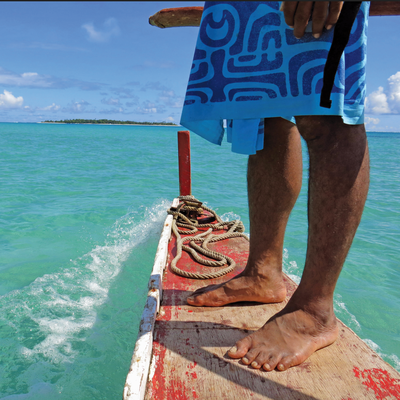
FIJI & BEYOND: A MacArthur Fellow takes stock of climate change loss and damage — and immediate solutions By Stacy Jupiter Under threat: Low-lying islands and coral cays, like barrier islands Wallis and Futuna, are extremely vulnerable to impacts of sea level rise. Photo by Stacy Jupiter. In August 2019, as Pacific Island leaders arrived to their annual forum leaders meeting in Tuvalu, an atoll nation of less than 12,000 people with its highest elevation at 15 feet above sea level, they were greeted by children submerged in water in a moat around a model of their sinking island holding...
Day Begins Here
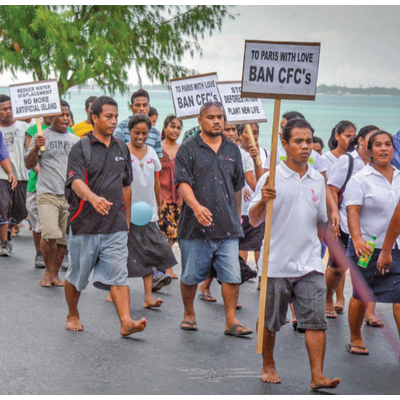
Kiribati: Land is tied to identity. But the land is vanishing. By Michael Roman Kiribati is the center of the world. Here the international dateline crosses the equator. It is the only country to have territory in all four hemispheres—north, south, east, west—and the first nation to see the sunrise of each new day. It is also predicted to be one of the first nations to vanish because of global climate change: summoning powerful king tides, devastating cyclones, and prolonged droughts. In the face of all this, how does a people stay resolute and try to preserve land—and a deeply...

Dengue Fever Blues
The Marshall Islands: Climate change and healthcare By Jack Niedenthal I work with a group of health care workers whom I will forever consider to be heroic. And this is why this is so: In the Marshall Islands climate change to us is not a “threat,” it already weighs heavily upon our island lives each and every day. Climate change not only means battling periodic inundations from rising sea levels that began to become routine in 2011, but now it also means fighting numerous and unpredictable disease outbreaks. And it will undoubtedly continue in this manner well into the future. This...

Writ on Water
Tonga: Lessons and memories, hopes and fears By Siotame Drew Havea Forty years ago I started working with Peace Corps Tonga. When I came on board in the mid-1980s as training director and then associate director, our two main projects focused on education and health. We had also launched an agricultural project, focused on research and agribusiness, in the 1970s. Some of our volunteers complained of not enough happening in their structured jobs. So we made sure volunteers’ time and energy went to secondary projects focused on the environment. Volunteers worked directly with farmers and community members to plant trees—to...

Tilting with Windmills
Connect turbines from wind alley to where people need the juice, and you could transform the American energy grid. Even get us to 50 percent renewables. That was Michael Skelly’s grand vision. By Russell Gold This is not a story with a happy ending — yet. It’s a tale of former Peace Corps Volunteer Michael Skelly (Costa Rica 85-87), who set out to build an interstate energy transmission superhighway system. Over a decade, the roadblocks proved immense. Here are excerpts from Superpower: One Man’s Quest to Transform American Energy by Russell Gold. When he was 25 years old, Michael Skelly felt directionless. He wrote...

What Global Issue Do RPCVs Care About Most? Climate Change
So here’s what we’re doing next. By Glenn Blumhorst In January 2020 National Peace Corps Association conducted a national survey asking you about the global issues that you care about most — and what actions you might take to address these issues in your community. More than 3,000 members of the Peace Corps community responded. Nearly two thirds of you said climate change was by far the global issue you cared about most. You also showed strong support for global health, access to clean water, and women’s empowerment and girls education. Since January, we have learned an important lesson: Without proper preparation, existential threats like...