

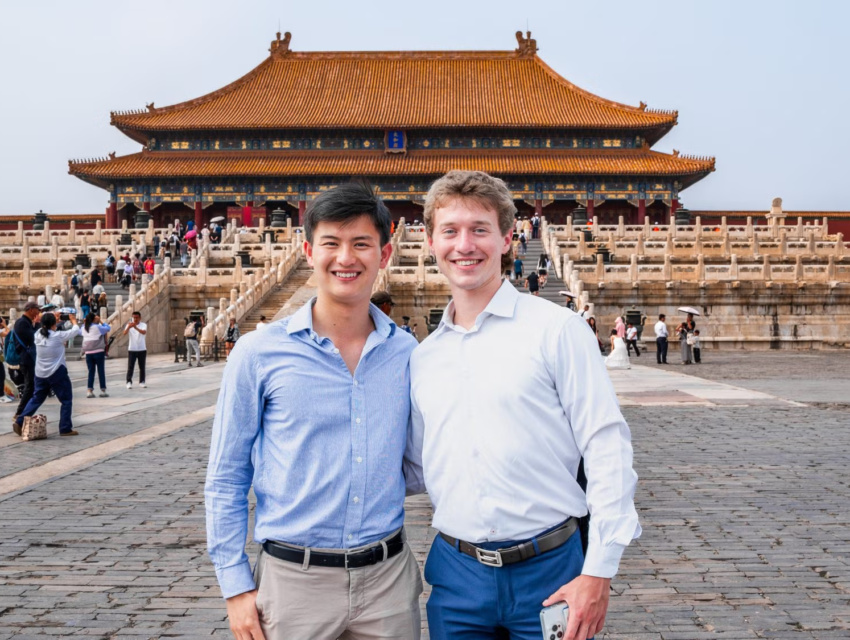
Your Next Adventure Comes With a Degree
Graduate school abroad offers RPCVs new adventures, global connections, and often a more affordable path to a degree.
One thing most RPCVs can say is that they are well-versed in navigating culture shock, but it’s surprising how hard it can be to adjust to life back home. Old routines can feel small; “normal life” can feel mundane in the familiar.
For those whose thirst for life in another language wasn’t satisfied by two years of Peace Corps service, graduate school is another opportunity to prioritize learning outside just the classroom.
But where to start? Navigating international degree programs, visas, and costs can feel daunting, so WorldView has put together a quick guide on pursuing a master’s degree abroad to show you how a degree in a far-off place can actually be within arm’s reach, with real insights from RPCVs who followed that path.
Kevin Nolan (Morocco 2001–03) sees an international grad program as a natural fit: “It makes perfect sense that the kinds of people that are drawn towards the Peace Corps experience — embracing both the challenges and opportunities in serving in a foreign country — would seek out a graduate program abroad as well. RPCVs have demonstrable experience thriving in unknown cultures and locales and are the kinds of people that find the journey of navigating the post office, local market or getting a haircut in a new country a rewarding adventure.”
For many RPCVs, the learning that comes from adapting to a new environment, or language immersion, is the real value of education. A degree abroad can facilitate the same type of learning.
Beyond the cultural benefits, there are also practical advantages to an international education. Many programs abroad are shorter than their US counterparts, often offering degrees in one year of instruction rather than two, a common approach in the UK. Tuition can also be considerably lower in Europe, Asia and Oceania, or even in closer neighbors like Canada — sometimes coming to less than 10% of the cost of a U.S. education.
Beyond the degree, professional networking that comes from such a program extends beyond US borders, a particular advantage for those looking to build an international career.
Jake McGrew (Ukraine 2013-14) saw a master’s abroad at Central European University in Budapest as a natural extension to his work in the field in Ukraine. His cohort included just two Americans among the 24 countries represented, enabling him to build a highly diverse, far-reaching professional network. After graduating, this helped him pivot directly back into international education in Ukraine.
That motivation – leveraging the experience gained in the Peace Corps into a region-specific career path is quite common for people who have spent years learning a language that may not have as much utility outside the country they served in.
It’s even applicable for people who made only limited progress in learning the local language, with some foreign programs taught entirely in English. This isn’t always the case but it allows language learning to continue without affecting the subject-specific learning at the core of the degree.
And a Peace Corps assignment is often transferable to a number of careers. Programs in public policy, global health, environmental studies, or development are common landing spots after Peace Corps to build on the skills already developed in the field.
Nolan emphasized that thorough research is essential to understand the accreditation, curriculum structure and coursework offered from each program.
“In my experience earning an M.A. at the American University in Cairo,” Nolan said, “the coursework and university itself were aligned with my expectations, though the experience of living in a central part of such a bustling and dynamic city like Cairo required patience, flexibility and adaptation—skills I had undoubtedly honed in my Peace Corps service.”

American University in Cairo, Egypt
As always, it’s essential for an applicant to do their due diligence to verify language requirements, visa considerations, certification of transcripts and the like. For applicants looking abroad, it is even more important to start early.
Ultimately, however, the lengthy administration process is worth it if you know why you want to study abroad. For McGrew, that clarity made it simple for him to find the right program, and to get the most out of it.


Related Articles

Friedman School of Nutrition Science and Policy at Tufts University
As the only stand-alone graduate school of nutrition in the United States, the Friedman School is dedicated to advancing health,…

RPCV Campus Ambassadors
Campus Ambassadors are carefully selected, degree-seeking students who represent and promote Peace Corps on their campuses. They receive a per-semester…

Think Fulbright is Just for Students? Think Again.
Did you know that you don’t need to be enrolled in graduate school to become a Fulbright scholar? For people…