


Make it (Field) Work
Graduate school took these RPCVs from the Andes to Mongolia and further from their original plans than they ever expected.
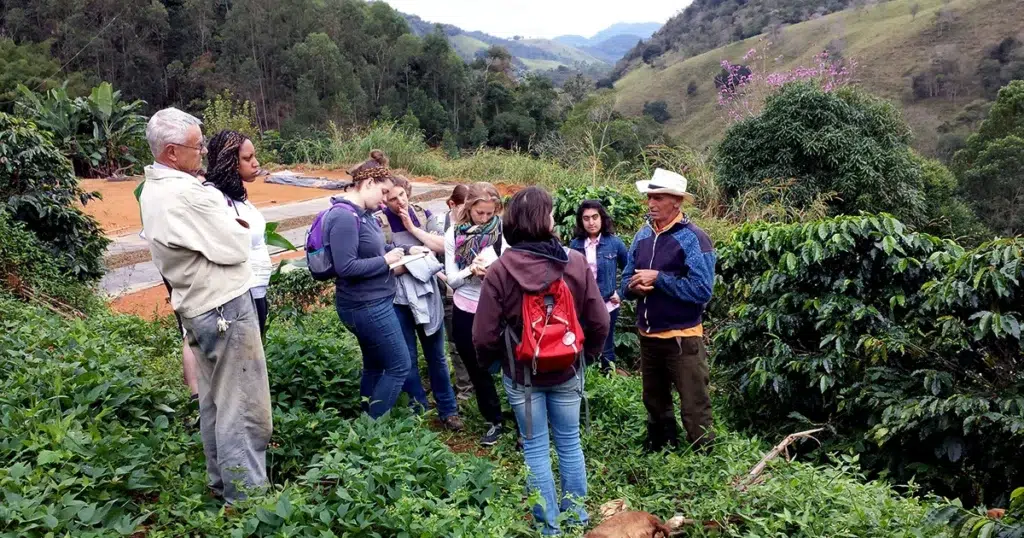
Ask five people what grad school looked like as a complement to Peace Corps service, and you won’t hear much about seminars. Somewhere between the thesis and the practicum, a volunteer inevitably finds themselves barreling down a mountain on a bike with a dozen kids trailing behind — and realizing, mid-descent, with certainty that there’s no going back to who they were before.
They might instead tell you about defending a class assignment over Zoom from inside a mosquito net during a 48-hour blackout, or taking the GRE in a Mongolian village at twenty degrees below freezing.
A graduate degree doesn’t just have to mean four walls and a syllabus. It can mean multiple rounds of rabies shots, a girls’ soccer league that mobilized an entire community, or getting adopted by a troupe of grandmothers teaching traditional dances instead of following a well-researched community-development plan.
WorldView sat down with five Peace Corps volunteers who paired graduate study with Peace Corps service and heard their stories of wild escapades, further proof that the adventures don’t have to stop when you sign up for a graduate degree.
If anything, things can get a whole lot wilder.
Lucie Rutherford
Graduate study: University of Virginia (Jan 2022 – May 2023)
Degree: Master of Public Health, with a focus on Health Policy, Law, and Ethics
Peace Corps service: Peru, 2023 – present
Graduate fieldwork: Phnom Penh, Cambodia; mental-health research with a partner clinic. Also completed a remote internship supporting an NGO working in Kenya.
In Peru’s mountainous Ancash region, where palm trees and snow-capped Andes rise on either side of a wide valley, Lucie Rutherford is serving her third year in the Peace Corps. The photo from her service that always makes her laugh reveals a boy in one of her grant-funded cooking classes with “chocolate mousse” dribbling down his chin, all smiles as, unbeknownst to him, the mousse is actually cooked animal blood blended with mango.
“Anemia and malnutrition were a huge issue in kids — 48% of kids under three in the district had it,” Lucie explains. Blood, it turns out, is cheap, iron-rich and, when disguised with enough mango, surprisingly easy to get a child to eat.
Lucie wrote the grant during her second year of Peace Corps service that she treated as extended field work from her graduate degree in public health.
“It gave me a lot of agency, and I think it gave me the ability to believe in myself and take initiative on a project,” she says. More importantly, the work let her stop guessing about public health and notice which parts of it actually engaged her.
“Growing up, I knew I didn’t want to be a nurse or a doctor, but I loved the idea of working in public health on a person-to-person level, internationally, and if I really had to analyze my history, I think my time in the Peace Corps has shown me that this is indeed what I want to do,” she reflects.
In some ways, Lucie’s path toward international public health seems almost obvious: her mother was a nurse, and her father also served in the Peace Corps. She grew up with their stories woven into the fabric of her childhood. For her, service wasn’t so much a leap into the unknown as a definitive ‘yes’ to a path that had looked interesting in a classroom and needed testing in the field.
The adventure she found there led her to pursue a third year as a way to develop the experience that will propel her for the rest of her career.

Sina Barzegar
Peace Corps service: Timor-Leste, 2023 – 25
Graduate study: University of Pennsylvania (2025 – 26); first semester online during service, followed by a spring semester in Philadelphia
Degree: Master of Science in Nonprofit/NGO Leadership (Coverdell fellow)
Graduate fieldwork: Practicum with Women Against Abuse in Philadelphia, initially conducted remotely from Timor-Leste, with related collaboration involving ALFeLa in Dili, Timor-Leste
By the time Sina Barzegar finished his Peace Corps service in Timor-Leste, he’d been through six rounds of rabies shots after several dog bites and one badly misjudged attempt to ride a horse. “The horse did not want me to get on it,” he admits. “That one’s admittedly my fault.”
Sina lived with a host family in unglamorous conditions, but grew to love life in Timor-Leste — so much so that he wanted to reorganize the rest of his life around it. And how could he not? Rats lived in his mattress, dogs bit him regularly, and he shared a squat toilet with a handful of kindergarteners.
And yet, he says, “joining the Peace Corps is the single best decision I’ve made in my 26 years. It changed my life.”
Before Timor-Leste, Sina had practical experience in accounting. “I was making a difference for investors and C-suite executives who didn’t even know my name,” he says. The contrast with Timor was stark: “The corporate guys didn’t care about me; they just cared about what’s in their wallet. But over in Timor, people actually cared about you as a person, and we were both working toward a real goal to help each other.”
At the time, Sina was dreaming of a career with USAID and figured a master’s degree would get him closer, and he was eager to get started. With his country director’s permission, he enrolled in an online nonprofit-leadership program at the University of Pennsylvania. He bought Starlink and two industrial-size batteries to survive the village’s routine 48-hour blackouts.
“It was me in the Zoom box with the mosquito net,” he says, “and sometimes I was in the dark, so I’d have my iPhone flashlight — it’d be like I was telling a scary story,” he laughs.
His practicum paired him with Women Against Abuse, a Philadelphia nonprofit offering free legal services to domestic-violence survivors, while he worked with an organization doing similar work in Timor-Leste. “I could take the theory from class and apply it to real NGOs, and bring what I was learning on the ground back to the classroom,” he says.
By his final year of service, Peace Corps service and a master’s degree no longer felt like enough. He tried to take the LSAT from his village, but after the internet cut out four times, he had to fly to Darwin, Australia, to take the test.
Now in his first year at Temple Law, he’s a long way from his village in Timor-Leste, but also from the career he once planned. The one thing he has found he can rely on is his instinct to chase the dream of something bigger than himself, armed with the knowledge that that dream manifests on the ground, with real people.

Emilie Romero
Peace Corps service: Honduras, 2008 – 10
Graduate study: The New School (2011 – 13)
Degree: Master of Arts in International Affairs, Media and Culture concentration (Masters International program)
Graduate fieldwork: Rio de Janeiro, Brazil; taught children in a favela to create documentaries about their community.
Emilie Romero speaks about her time in Honduras in fragments as she refills water bottles and cheers on goals from the sidelines of an elementary school soccer scrimmage in Costa Rica, where her family recently moved. One of the biggest gifts from a life rich with study abroad and Peace Corps service was knowing that there are a thousand ways to live a life, and that the one she had built in the US was not the only one that carried meaning and purpose.
By the time Emilie became a Peace Corps volunteer in Honduras, she had already studied abroad four times. As a municipal development volunteer working out of the local women’s rights office, she taught art history to elementary schoolers, ran health and empowerment programs for teenage girls, and started a girls’ soccer league.
She kept hearing that girls didn’t play sports — or that the ones who did were all queer — and set out to correct the record. The team was a huge success, and, it turned out, open to diverse sexualities. What began as a soccer league became a safe place for queer women to gather, play, and be themselves. Many years later, several pairs of teammates who met through it are still married, which is incredibly rare in small-town Honduras.
After her service, Emilie attended The New School in New York City, focusing on media and culture, with a new inspiration for what community change can look like: giving young people the space and tools they need to tell their own stories and imagine different possibilities for their lives.
Her practicum for the degree took her to Rio de Janeiro, where she taught children in a favela to make video documentaries about their neighborhood. Her résumé then wound through Human Rights Watch, UNICEF, and the National Economic and Social Rights Initiative before veering into marketing and UX design.
“A lot of what I learned in Peace Corps — holding workshops, holding space, practicing design thinking — I still use, and it’s really valuable,” she says. “It just wasn’t a clear path.” While in the Peace Corps, Emilie realized she loved building things. She had been, in many ways, a creative project manager solving problems, making things work, and following good ideas wherever they led. The job title came later, but the instinct was already there to create something people needed, then leave enough room for it to become something she hadn’t planned.
Years later, standing on another soccer sideline, fringed with palm trees and the cries of toucans, she can see just how far that approach she solidified in her graduate field work has carried her.
Claire Bodger
Peace Corps service: Mongolia, 2023 – 2025
Graduate study: Fordham University (2025 – 27)
Degree: Master of Arts in International Political Economy and Development (Coverdell Fellow)
Graduate fieldwork: New York City; internship with the Bureau of Immunization at the Department of Health and Mental Hygiene, using economic modeling to study vaccine uptake.
Claire Bodger was raised by parents she calls, without irony, “the original anti-vaxxers”: she was homeschooled on a California farm and unvaccinated for the first 18 years of her life. Now she is an intern at New York City’s Bureau of Immunization, building economic models to persuade more people to do the thing her parents refused.
As a teenager, Claire joined medical missions to Haiti, Sri Lanka, and Cambodia, checking strangers’ blood pressure from a backpack on their porches. In rural Cambodia, she recorded 10 dangerously high readings in a row and asked the physician she worked with why that was the case. The food that helps keep blood pressure down, he told her, was priced out of reach for most people. “It seemed like a betrayal of the human condition,” she says, “that the only food available to someone could shorten their life by ten years.”
After two years of COVID-related delays in her acceptance to the Peace Corps, Claire landed in western Mongolia, where yaks wandered freely through town. Working through a near-total language barrier with the school psychologist, using equal measures of enthusiasm and Google Translate, she started a psychology club for local high schoolers. It worked so well that after she left, the students asked to run it themselves. The reason, she says, was simple: people wanted it, a small but critical detail often lost in classroom study of international development.
She applied and was accepted to a graduate program at Fordham University in New York to pursue an MA in international development economics–and took the GRE from her village in minus twenty degree weather, the day after the 2024 election, on an internet connection that was shaky at best.
Claire’s original plan of working with USAID is no longer on the table, but it hasn’t shaken her resolve. If anything, the work feels more urgent. “It’s not made me rethink my career choice because it seems more urgent than ever, especially with health, especially with how the loss of USAID has directly contributed to the suffering and deaths of millions. Peace Corps has helped me see the grounded perspective of how development actually works, and that the partnership of the community and the enthusiasm of the community is completely foundational to any work that anyone does.”
Nicolette Slagle
Peace Corps service: Thailand, 2011 – 13
Graduate study: Illinois State University; coursework before Peace Corps service and thesis afterward
Degree: Master’s with an Applied Community and Economic Development sequence (Master’s International program)
Graduate fieldwork: Rural Thailand; community development work with a women’s weaving group, informing her thesis through Master’s International.
Ask Nicolette Slagle what her community in rural Thailand wanted from her over her two years of service and field work for a master’s degree in “sustainable development,” and she doesn’t hesitate: “Everyone pretty much just wanted me to teach English and find them American husbands.”
She came through Illinois State’s Peace Corps Master’s International program: a year of coursework, two years of service, and a thesis on being a cross-cultural “change agent.” Her project sounded impressive on paper — a grant-funded effort to build a natural-fiber weaving industry with a local women’s group, government support, and a plan to export textiles. On the ground, she confronted a more basic question: “There wasn’t going to be another person coming into that community the year after me,” she says. “So what’s the point?”
What succeeded was never in the grant application. Nicolette spent her free time with the town’s traditional dance troupe made up of older women who adopted her, taught her their routines, and showered her with affection. “Maybe that;s not exactly what they thought they were getting when they signed up for a Peace Corps volunteer,” she says. But it may be the most honest description of what volunteers do: become a thread in the community tapestry.
“No matter what they say the three goals of Peace Corps are, at the end of the day it’s soft diplomacy. That’s what it is,” she says.
Grad school had at least prepared her for the possibility that being a change agent could take many forms — and one of them was dancing barefoot in dappled sunlight with a bunch of grandmothers.
Nicolette has since embraced the fluidity of her path. What draws anyone to this kind of work and study is more than the belief that they can change the world. It’s the hope of being changed themselves, abandoning pre-made plans, and having a good time along the way.
Amy J. Miller (Thailand 2009–11) is a writer and graphic designer whose work focuses on food justice, international travel, and service.


Related Articles


The Art of Applying in the Age of AI
Conscientious applicants must leverage AI tools responsibly, and in line with the core Peace Corps value of empowering people, rather…

Degrees of Freedom
Some graduate schools take a different approach to what can be considered non-traditional experience, enabling students to design their own…

Wave of Inspiration
A decision to join Peace Corps begins with one person simply telling another what service meant to them. A former…