

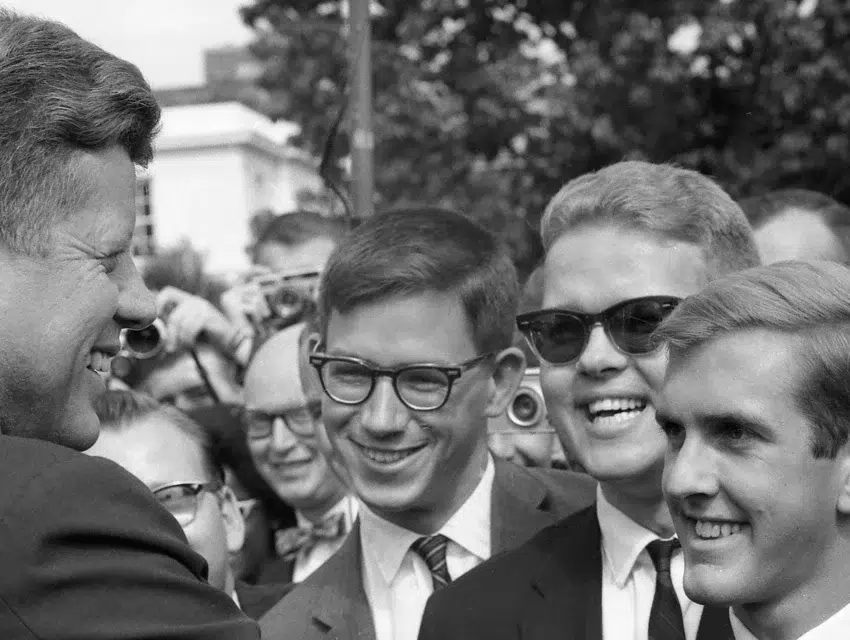
We Don’t Need Photographers, Kid.
How Rowland Scherman became the eyes of a generation and the first Peace Corps photographer
Rowland Scherman was in Togo, West Africa, flirting with a Volunteer in a hotel swimming pool when he heard gunshots. One hundred yards away, President Sylvanus Olympio had just been assassinated in a military coup at the nearby presidential palace. A CIA agent, equipped with heavy weaponry, ordered Scherman to remain in place. He recalls streets lined with large men carrying machine guns and drinking heavily and swinging their weapons with reckless ease. As an ambitious young photographer, his instinct was to move toward the action, but he followed the order and remained safely in place.
“If I knew then what I know now,” Scherman says, “I would have slipped out and bullshitted the drunken troops about getting visual photographic proof of the president’s death, or some nonsense about documenting the heroes of the revolution, and photographed Olympio lying face down mortally wounded in the garden of the president’s palace a six-iron golf shot away.” The image, he knew even then, would have been syndicated worldwide. It might have made him a small fortune. It might have won a Pulitzer.
“Anyway,” he says, “I did not get the picture.”
It may have been the last time Scherman obeyed an order to stay put. In the years that followed, he would push past velvet ropes and security guards to slip backstage without credentials and photograph a generation of rising stars, including Bob Dylan, Joan Baez, and The Beatles, in images that would later become iconic.
But before coups and missed Pulitzers, before fake credentials and learned defiance, Scherman had been inspired by a different call to action, one that came not from folk music or violence but from a young American president on the campaign trail in the middle of the night.
When John F. Kennedy arrived at the University of Michigan on the evening of October 4, 1960, he asked students a surprising question: Would they be willing to serve their country abroad?
The response was electric. Kennedy had intended to say a few words and go to bed. Instead, he realized he had stumbled onto something larger, a movement that was politically and morally alive. Somehow that speech made its way to Scherman, who was producing portraits for a few bucks a shot out of a homemade darkroom in New York City.
When Kennedy later implored Americans to, “Ask not what your country can do for you, ask what you can do for your country,” Scherman boarded the next train to Washington, D.C. There he joined the rush of idealists flooding into the nation’s capital to take part in a new government program unfolding in real time. When he arrived, he saw offices overflowing with desks, reporters, and recruits alongside a harried director, Sargent Shriver, trying to make sense of it all.
Scherman announced himself ready for service as the Peace Corps’ official photographer.
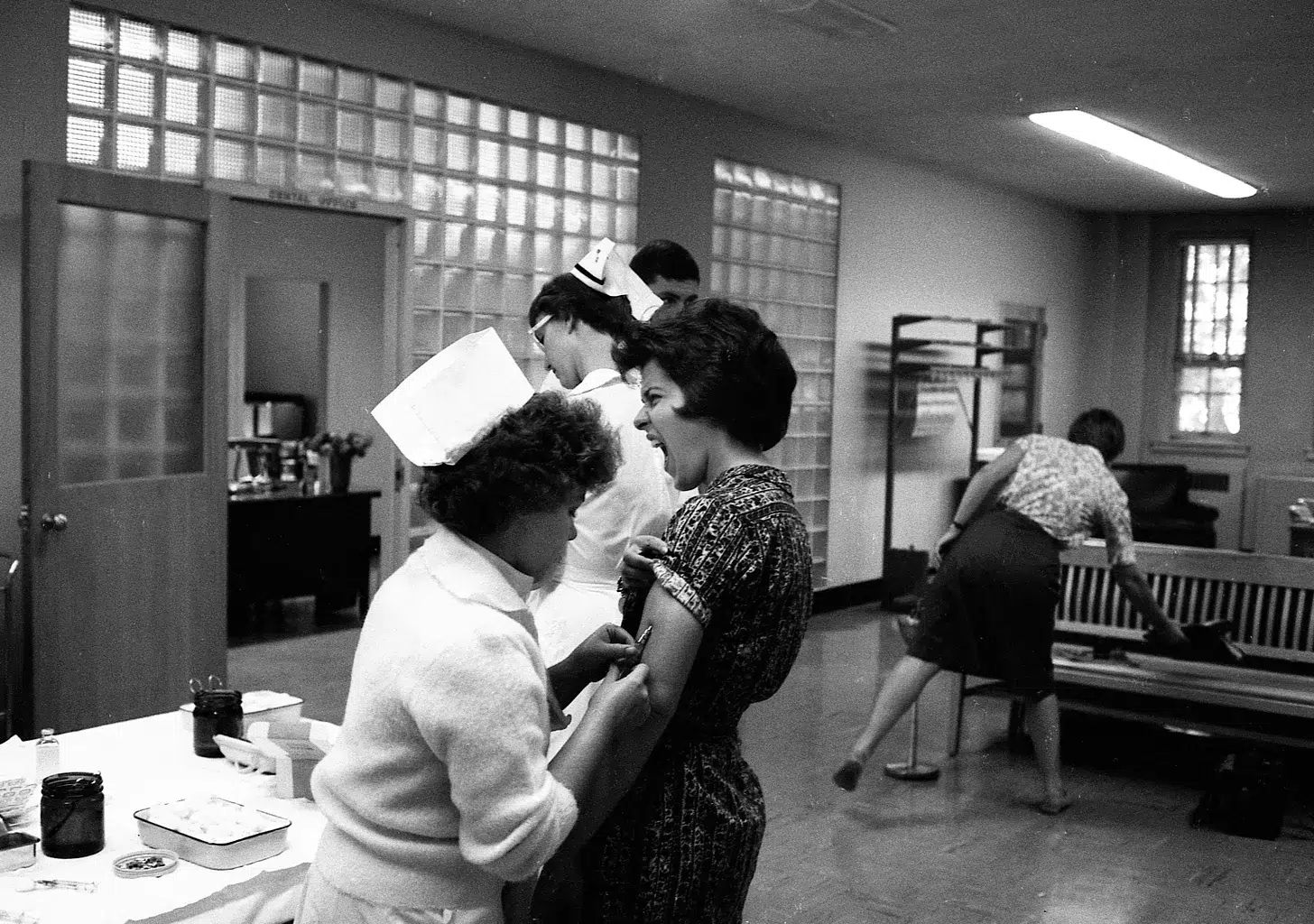
Shots for early Peace Corps Volunteers were mandatory.
“We don’t need photographers, kid,” he was told. “We need doctors, farmers, nurses, technicians.” They waved him away. But Scherman stayed close. A few days later, after the press had dispersed, Princess Beatrix of the Netherlands requested a photograph with Shriver. Scherman was there, camera ready. It was the first of many times when being close to the action opened the door to his next job. He landed the gig.
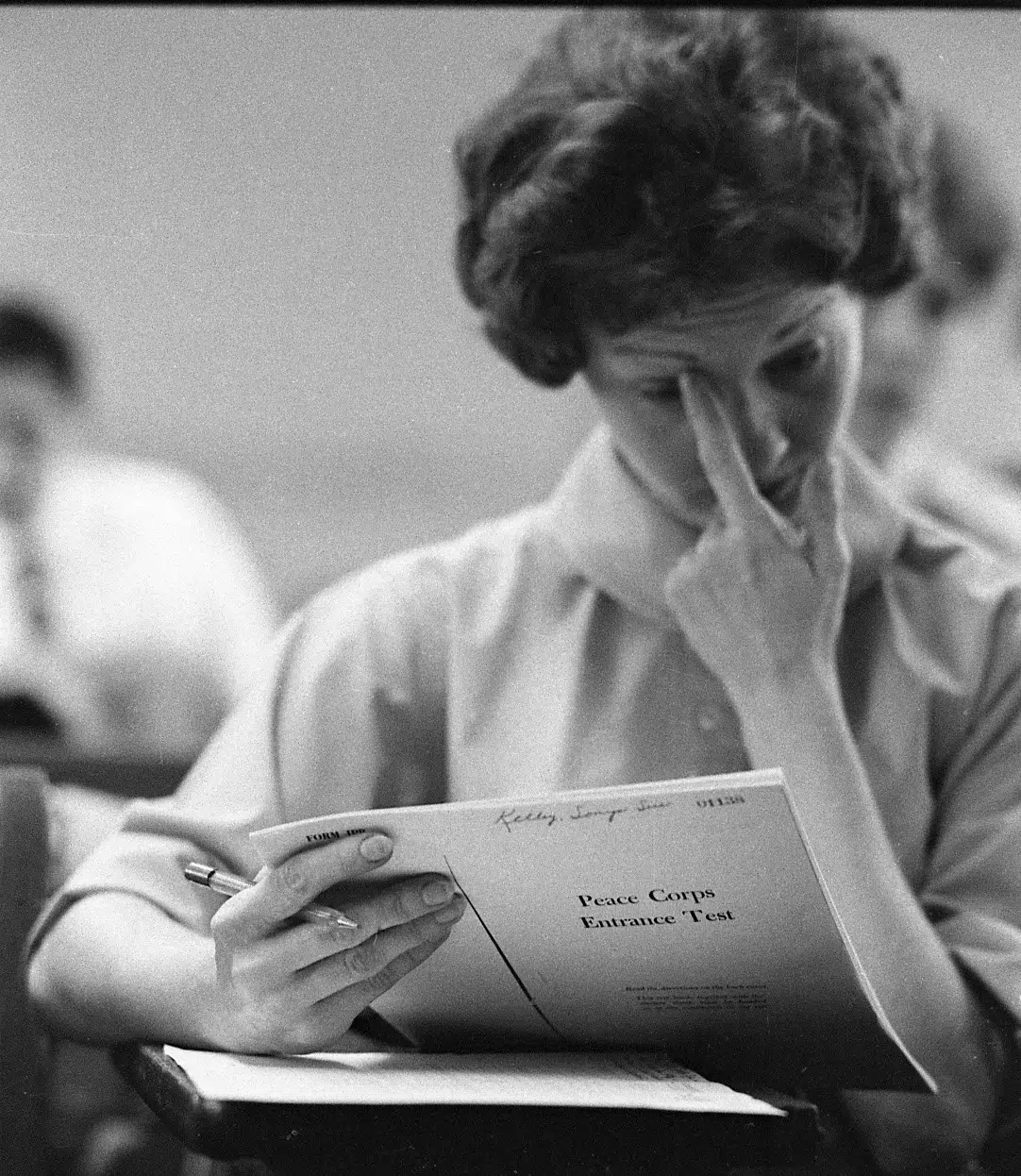
A Volunteer applicant taking the written Peace Corps exam in 1961.
In the beginning, Scherman’s work focused primarily on photographing speeches and later, on Volunteer training. Early Peace Corps Volunteers faced Outward Bound-style challenges in preparation for deployment. They rappelled off mountains, swam long distances in the ocean, and went on survival treks. These activities often took place in Hawaii or Puerto Rico. Scherman photographed it all. Ultimately, the program gave in and sent him overseas. The agency was tired of not getting usable photos from field officials. “A lot of big shots came back with nothing,” Scherman says. “They were lawyers, not photographers.”
Scherman was different. They gave him film, access, and an official black passport marking him as on assignment for the U.S. government. “You can’t imagine how proud I was,” he says.
Scherman wasn’t just documenting the birth of the Peace Corps; he was witnessing America shape a new kind of foreign policy. Long before the term “soft power” was coined, his photographs suggested that influence could be built through generosity and human connection rather than force.
“We were Americans doing the right thing,” Scherman says. “And people knew it.” He remembers being cheered. Honored.
“We were Americans doing the right thing, and people knew it.”
“We’d be in canoes deep in the jungle in Togo, wearing Kennedy T-shirts, and everyone loved us. Children clustered around Volunteers. Teachers posed proudly with their classrooms. It’s hard to believe now, but it was true.” His photographs froze a moment in time painted with youthful idealism.
After three years on the road photographing Volunteers in more than fifteen countries, Scherman left the Peace Corps in 1963, telling Shriver he was ready to go on his own as a freelancer. At only 26, his work covering the music scene, civil rights movement, and other iconic moments of the 1960s was published in nearly every major American magazine. Those images helped define an era, just like his photos from abroad. His images revealed a nation wrestling with its own contradictions, even as they preserved the fragile hope that a more equitable world was possible.
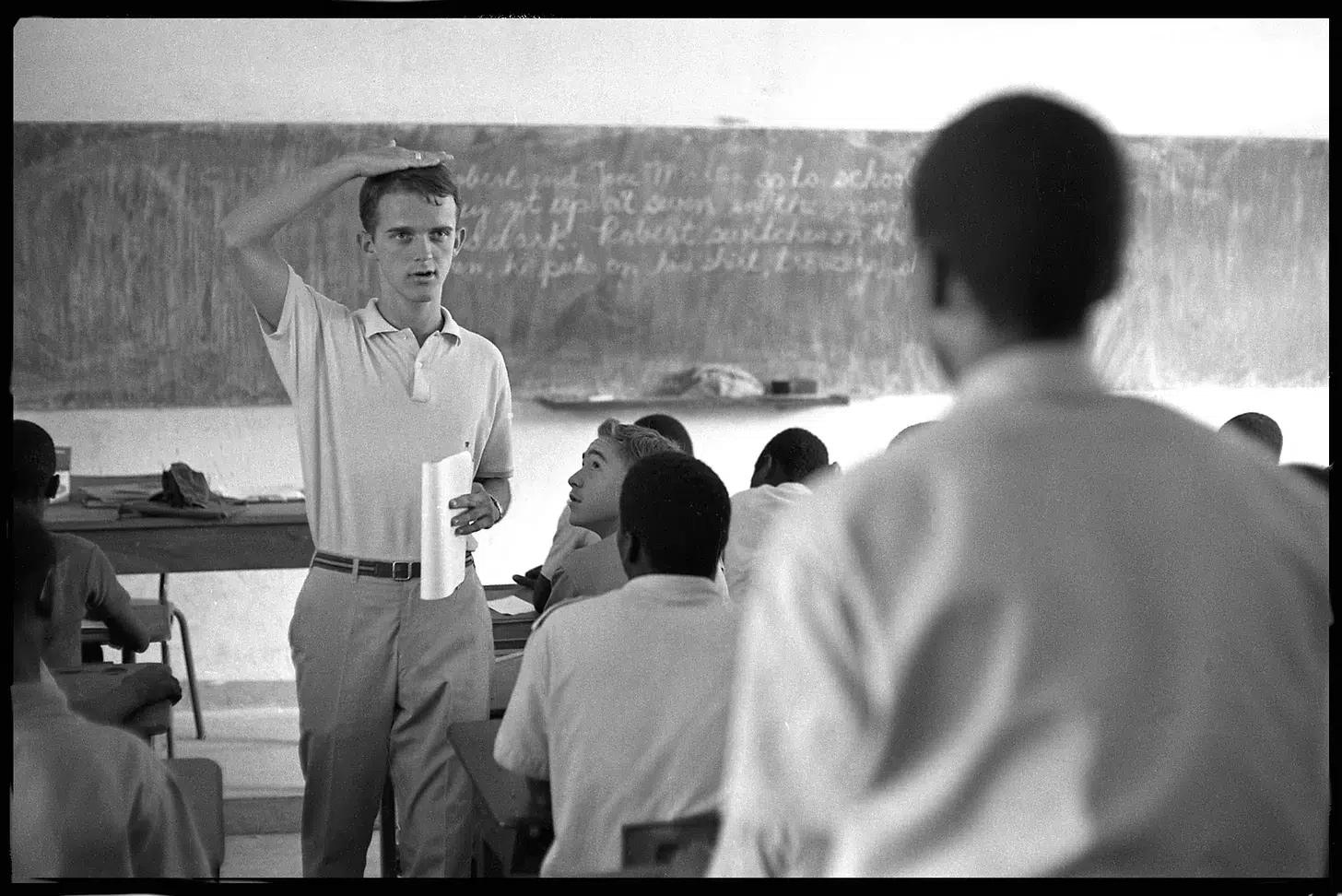
An early Peace Corps teacher in Togo.
For Scherman, that idealism did not last. Kennedy’s assassination marked the start. Then came the Vietnam War. He sensed a growing gap between idealism at home and a lack of moral authority overseas. Over the years, the easy affection Scherman photographed started to seem conditional and, eventually, hard to find. At 88, Scherman feels that loss acutely. He speaks today with open frustration about contemporary politics, about the chasm between the country he was inspired to love and the one he now watches from a distance. Loving America, he says, now feels more challenging. Still, he’s proud to have documented so much of its potential.
“Doing what I could for my country made my career,” he says.
Time has narrowed his world. “Back then, I looked a lot younger than I was. I was cute, slender, and athletic. Now I’m 88, and I can hardly flipping move,” he chuckles. Scherman is certainly no longer rappelling off mountains. His pacemaker falters. He can’t join his wife for her morning walks with the dog. Many of the people he once photographed—siblings, friends, his first wife—are gone. From his home near the ocean in Massachusetts, he writes a weekly Substack, assembling memories piece by piece.
His all-time favorite photo is one of the first he ever took. It features his brother with a model airplane made during Scherman’s summer job at Life magazine. “I could never write about him the way I felt,” he says. “But this picture captured that love. Writing is hard. Photography remembers for you.”
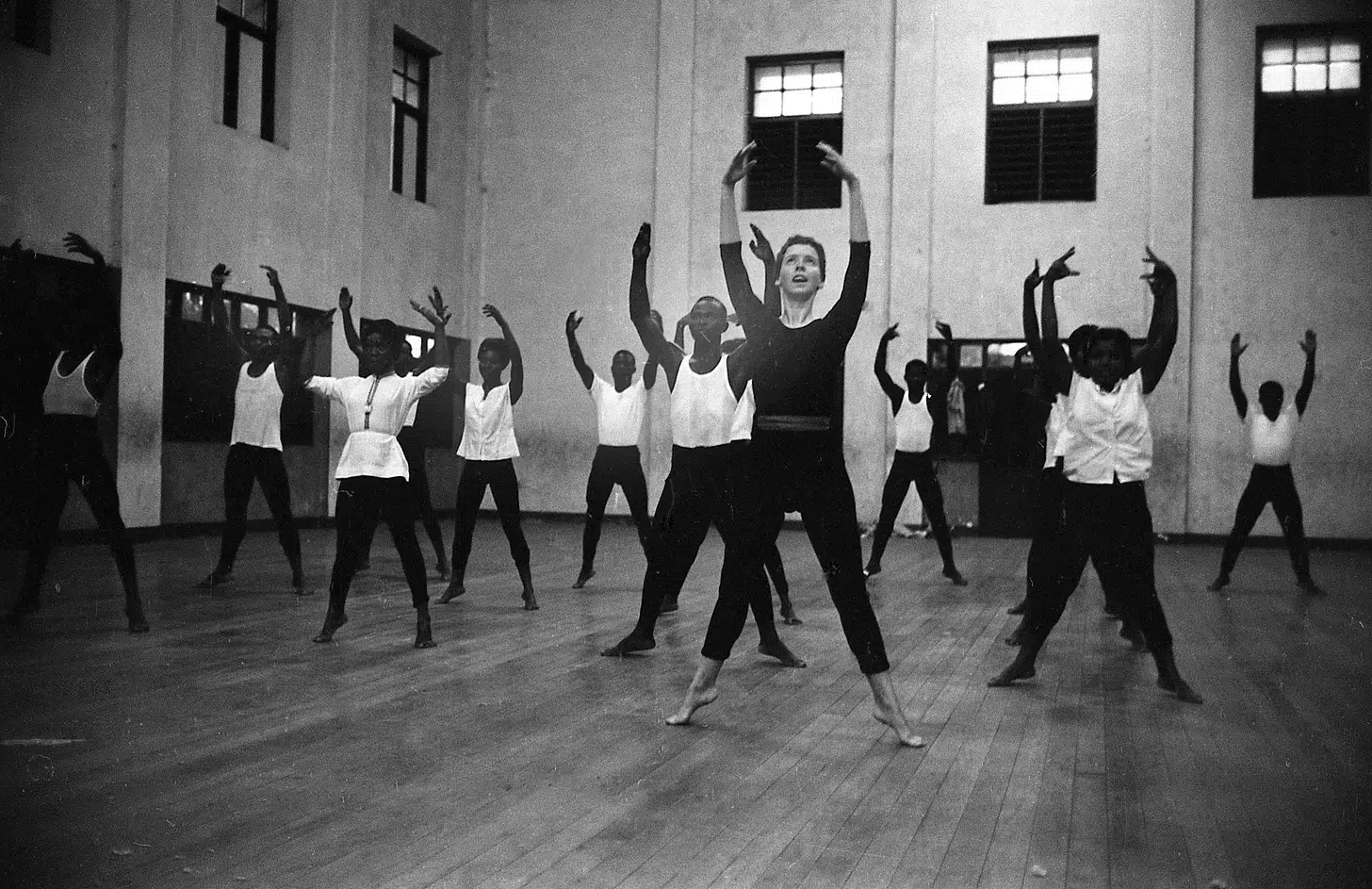
A Peace Corps Volunteer teaching a dance class at a school in Togo.
Scherman’s photographs of the Peace Corps now belong to the U.S. government—black-and-white images of young Volunteers heaving a boat into the surf, teaching crowded classrooms, standing beside Kennedy as they pledged themselves to a better world. In those frames, the United States appears briefly coherent, alive with the idea that relationships might be more powerful than brute force. They capture the version of America many, like Scherman, still invoke when they look at the news and mutter, this is not who we are. What the photographs ultimately show is not innocence, but aspiration and a country that has never stopped arguing with itself about what kind of power it wants to claim, much less present, in the world.
Amy Miller (Thailand 2009-11) is a writer and graphic designer whose work focuses on food justice, international travel, and service.


Related Articles

“Art of the Steal: Trump and the Economic Presidency” exposes playbook behind U.S. exploitation of the domestic economy
Returned Peace Corps Volunteer and bestselling author John Perkins explores the connections between U.S. foreign policy and domestic economic practices…

The Peace Corps Mission America Needs Now
What if one of the most important calls to action for RPCVs today is to broaden the aperture of the…

WorldView Guide to Graduate School Vol. 2
The 2026 WorldView Guide to Graduate School is a free digital resource from National Peace Corps Association (NPCA), created specifically…