


Hard Corps
The Evolution of Service, One Corps At a Time
A Domestic Version of Peace Corps
In February 2026, Peace Corps announced the launch of its newest program: The Tech Prosperity Corps. This new service opportunity, which aims to facilitate international development and economic growth in Peace Corps host countries through the adoption of artificial intelligence, marks the latest example of Peace Corps’ continuing legacy today. In the decades since Peace Corps’ founding in 1961, its success has sparked a movement of service-based organizations, many of which have incorporated the word “corps” into their name.
The word “corps” itself has long carried associations of shared mission, discipline, and collective identity. Derived from the French word for “body,” the term has historically been used to describe organized groups united around a common purpose, from the diplomatic corps to the United States Marine Corps. In the decades since the Peace Corps’ founding in 1961, that language of service and esprit de corps has inspired a wide range of civic and volunteer organizations to incorporate the word into their own names. Although the Tech Prosperity Corps may be the latest service program inspired by Peace Corps’ service-based mission, it is certainly not the first.
The Volunteers in Service to America (VISTA) program was created as a domestic analog to Peace Corps and signed into law by President Lyndon B. Johnson in 1964. Along with several other service programs, it was later consolidated under a new name, AmeriCorps, when President Bill Clinton signed the National and Community Service Trust Act of 1993.
“The AmeriCorps name reflects the idea of a corps of Americans serving their nation’s communities, echoing the tradition and esprit de corps of the Peace Corps in bringing Americans together through service,” said Jennifer Bastress Tahmasebi, acting head of AmeriCorps. “When I think about the term ‘corps,’ I think about the moments when people choose to show up for one another. It’s about showing up day after day with people who share your mission and your vision, even when it’s hard. But your individual efforts matter when you’re in a corps, as it’s combined with the effort of others in acts of service.”
Around the same time, AmeriCorps took its modern shape in 1993, and other service-oriented programs began forming in the nonprofit and nongovernmental organization (NGO) sector. One such organization was EarthCorps, which was founded by RPCV Dwight Wilson (Chile 1981, Honduras 1982–83) a decade after his Peace Corps service ended.

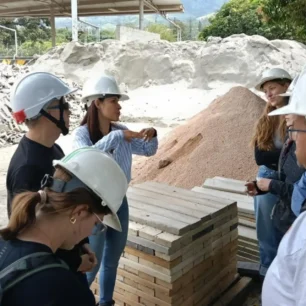
CorpsAfrica founder Liz Fanning (opposite) with a group of volunteers on-site in Rwanda, and volunteers from EarthCorps (top left) and AmeriCorps/California Service Corps (top right, bottom left) in action. More than a few national service organizations have been inspired to incorporate the word “corps” into their names. California’s Chief Service Officer Josh Fryday has called Peace Corps the “gold standard” of service organizations.
EarthCorps accomplishes its mission by bringing volunteers to the United States to work alongside other international volunteers on environmental projects in the greater Seattle-Puget Sound area.
“EarthCorps brings together small, multinational teams to do year-round programs that include a wide range of environmental restoration projects,” Wilson said. “‘Corps’ is about collaboration and working on a team with people from around the world to strategize, plan, and fix something. It’s hard work, but it’s something the world needs a whole lot more.”

Likewise, Atlas Corps was created in 2006 by former Peace Corps Associate Director for Global Operations Scott Beale to bring trained professionals to the United States to work and serve in the private sector.
“Atlas Corps’ mission is to develop leaders and strengthen organizations through an overseas fellowship to address critical social issues,” Beale, now CEO of ISC2, a nonprofit association for cybersecurity professionals, said. “Americans have had volunteers overseas for 50 years, but there have been few opportunities for young professionals from the Global South to come volunteer in the United States. So Atlas Corps is almost like a ‘reverse Peace Corps Response,’ where young professionals come from overseas to work in the United States for 12 to 18 months.”
Today, the program has the name Atlas Corps Leadership Institute and is part of the international exchange program Cultural Vistas. In the years since it began, Atlas Corps has brought fellows from over a hundred countries to serve with U.S.-based organizations such as Susan G. Komen for the Cure, Grameen Foundation, the American Red Cross, and Microsoft’s Social Impact Office, among others.
“Peace Corps and AmeriCorps were a direct inspiration for Atlas Corps, because ‘corps’ means there’s a team of people working together in a mission-driven endeavor,” Beale, who also serves on the board of the National Peace Corps Association, said. “Like Peace Corps Volunteers, Atlas Corps Fellows do it for the experience, the ability to give back, and the network they get out of it. Being a part of a corps means you have people who share your values, and the mission will continue even after you finish your term of service.”
“During my service, a young Moroccan woman asked me if she could be a Peace Corps Volunteer, and I had to say, ‘No, I’m sorry. It’s only for Americans,’” Fanning said. “Her question dogged me for 20 years, because young Africans deserve the opportunity to help their own country. The Peace Corps model is the best for international development: living with people for a long period of time, eating what they eat, sleeping where they sleep, learning their language, and becoming part of the community by building trust and friendship. We launched CorpsAfrica on March 1, 2011, the 50th anniversary of the Peace Corps, as a way of celebrating its incredible success by passing the baton to young Africans.”


Related Articles

Friedman School of Nutrition Science and Policy at Tufts University
As the only stand-alone graduate school of nutrition in the United States, the Friedman School is dedicated to advancing health,…


RPCV Campus Ambassadors
Campus Ambassadors are carefully selected, degree-seeking students who represent and promote Peace Corps on their campuses. They receive a per-semester…