
Meet the 2020 Winners of the Franklin H. Williams Award
Honoring six Returned Peace Corps Volunteers who have served around the world — and a leader who has worked to close the racial and wealth gaps in the Chicago area. By NPCA Staff On December 15 the Peace Corps recognized leaders in the Peace Corps community — and a civic leader with a shared commitment to Peace Corps values — with the Franklin H. Williams Award. The award honors ethnically diverse Returned Peace Corps Volunteers who have demonstrated a commitment to civic engagement, service, diversity, inclusion, world peace, and to the Peace Corps’ Third Goal — to strengthen Americans’ understanding of the world and...

From the Editor: This Time
Peace Corps teaches us a new way to think about time. Pandemic does, too. So what do we do with this? By Steven Boyd Saum ACROSS THE DECADES and countries and communities where tens of thousands of Peace Corps Volunteers have served, there are a few things we share. One: a new grasp of time. Be it seasons or how we count the days, a revised sense of punctuality or the value of hours in terms of money or daylight, be it devoted to sleep or preparing a meal or hiking to the well, be it in the presence of friends or alone with this self you are...

JFK at the Union: The Impromptu Campaign Speech that Launched the Peace Corps
Well after midnight on October 14, 1960, presidential candidate John F. Kennedy arrived at the steps of the Michigan Union. Legend has it that he first proposed the idea of the Peace Corps here. The truth is a little more complex, but far more interesting. By James Tobin Senator John F. Kennedy’s motorcade rolled into Ann Arbor very early on the morning of Friday, October 14, 1960. The election was three and a half weeks away. The Democratic nominee for president and his staff had just flown into Willow Run Airport. A few hours earlier, in New York, Kennedy had fought Vice...

Here’s how to get the WorldView app for free
Sign up to receive WorldView digital with our app, including searchable archives and digital exclusives. 1. Sign up for an account here. For a limited time, access is free using the code DIGITAL2020. 2. Then download the app from the iOS store, Google Play, or read the mag on Flickread on your computer here. Questions? Email us.

From the Editor: Unfinished Business
The evacuation of Peace Corps Volunteers serving around the globe is unprecedented. So is the way our nation is coming to terms with the truth that Black Lives Matter. By Steven Boyd Saum For most Peace Corps Volunteers, the news broke on the Ides of March: due to the global COVID-19 pandemic, every single one of them would be coming home. In its 59-year history, Peace Corps had never undertaken a global evacuation. But then, in so many ways, these are unprecedented times. In one sense, we feel the precariousness of institutions that we want to sustain — and...

The Unfinished Business of Peace Corps Volunteers Evacuated from Around the World
On March 15 more than 7,300 Peace Corps Volunteers were told they needed to leave the communities they had called home—an unprecedented global evacuation. They were uprooted from the lives and work they had come to know, sometimes without the opportunity to even say goodbye. They are returning to a country in crisis. National Peace Corps Association is working to ensure they have the resources they need during these uncertain and difficult times. We also want to make sure the world hears their stories. We are gathering here first-person videos and stories, as well as interviews with evacuated Volunteers from...

Words and Deeds
The weather: We talk about it but don’t do a blessed thing about it, right? Until we did, without intending to — into the Anthropocene era we rode, brave new world of climate instability. But that climate changing is accompanied by some very predictable results — at least for small-landed and big-oceaned island nations in the Pacific: catastrophic storms, king tides washing across communities, threatened fresh water supplies and health and well-being, and the very land itself disappearing. The first autumn that I served as a Peace Corps Volunteer in Ukraine — as the weather cooled and the names of the...
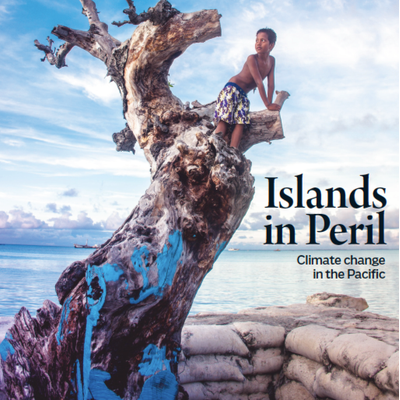
Islands in Peril
Climate change and Pacific nations heroically trying to save themselves By Mike Tidwell Dying trees, sandbagged shore. Photo for Humans of Kiribati by Raimo Kataotao At the United Nations building in New York, the national flag of every country on earth hangs from a pole outside. Whenever a new country is born — South Sudan being the latest in 2011 — a new pole is set up and a new flag raised. But what happens when a country dies? What happens, for example, if unchecked global warming wipes entire Pacific island nations off the map in the coming years? Will we have...
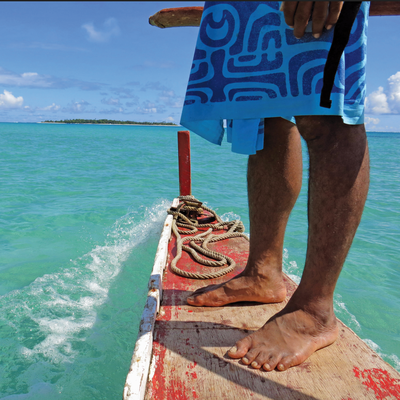
On the Front Lines
FIJI & BEYOND: A MacArthur Fellow takes stock of climate change loss and damage — and immediate solutions By Stacy Jupiter Under threat: Low-lying islands and coral cays, like barrier islands Wallis and Futuna, are extremely vulnerable to impacts of sea level rise. Photo by Stacy Jupiter. In August 2019, as Pacific Island leaders arrived to their annual forum leaders meeting in Tuvalu, an atoll nation of less than 12,000 people with its highest elevation at 15 feet above sea level, they were greeted by children submerged in water in a moat around a model of their sinking island holding...
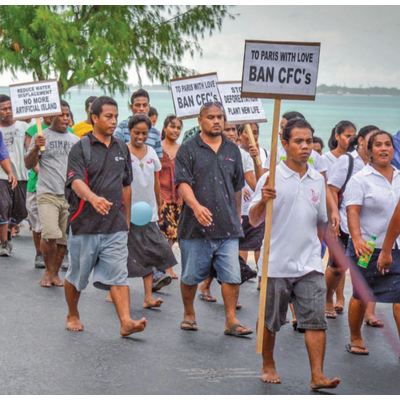
Day Begins Here
Kiribati: Land is tied to identity. But the land is vanishing. By Michael Roman Kiribati is the center of the world. Here the international dateline crosses the equator. It is the only country to have territory in all four hemispheres—north, south, east, west—and the first nation to see the sunrise of each new day. It is also predicted to be one of the first nations to vanish because of global climate change: summoning powerful king tides, devastating cyclones, and prolonged droughts. In the face of all this, how does a people stay resolute and try to preserve land—and a deeply...